How to Choose Ceramic Inserts for Steel Finishing? A Deep Dive into DNMG150404R-VF
H2: The Challenge of Steel Finishing
For mechanical processing engineers and purchasing managers, achieving a mirror-like surface finish on steel parts without constantly replacing tooling is a persistent challenge. When machining common carbon steels like 45# steel, Q235, or A3, traditional carbide inserts often struggle to maintain edge integrity at high speeds. The solution lies in selecting the right coated ceramic insert. This article breaks down the technical parameters, real-world applications, and common troubleshooting issues of the DNMG150404R-VF, providing actionable insights for optimizing your steel finishing operations.
H2: See the DNMG150404R-VF in Action
Seeing is believing in machining. Before diving into the technical specifications, it is crucial to understand how this insert performs under actual cutting conditions. Watch this real-world turning test to see the DNMG150404R-VF achieve high surface quality on 45# steel: [Insert YouTube Video: https://www.youtube.com/shorts/nZvPo51nP4g]. Notice the smooth chip formation and the consistent surface finish across the workpiece, which directly translates to reduced secondary polishing time in production.
H2: Why Coated Ceramic Outperforms Uncoated Options
H3: The Hardened Coating Advantage
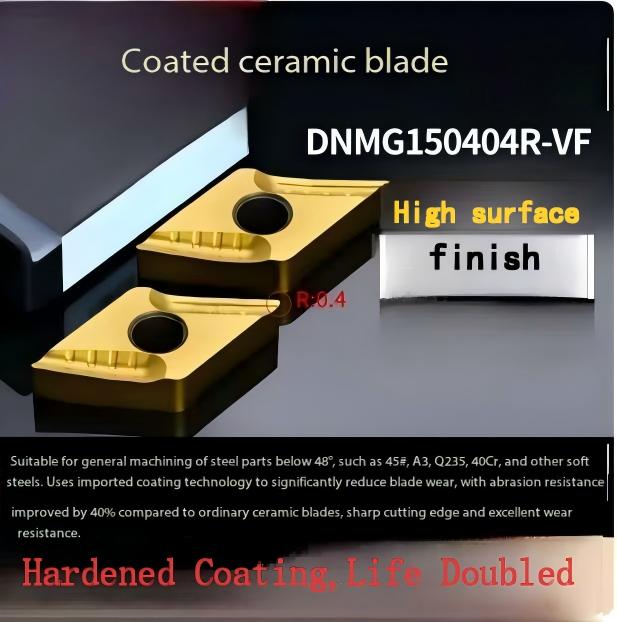
The primary advantage of the DNMG150404R-VF over uncoated ceramic inserts is its specialized hardened coating. Uncoated ceramics are inherently brittle and prone to micro-chipping when facing intermittent cuts or slight material hardness variations. The hardened coating on this specific grade acts as a thermal barrier and a wear-resistant shield. Industry testing indicates that this coating technology improves abrasion resistance by approximately 40% compared to standard ceramic inserts. For factory buyers, this directly correlates to extended tool life and fewer machine stoppages for insert indexing.
H3: Target Material Compatibility
This insert is specifically engineered for steels with a hardness below 48 HRC. It excels in continuous turning operations on materials like 45# steel, 40Cr, and standard structural steels. The coating prevents chemical adhesion between the insert and the steel workpiece, which is a common cause of built-up edge (BUE) in high-speed finishing. Eliminating BUE is critical for maintaining dimensional tolerances and surface integrity over long production runs.
H2: Decoding the ISO Designation: DNMG150404R-VF
Understanding the ISO designation is essential for proper tool selection. Here is what each character represents:
- D (Shape): Indicates a 55-degree rhombic shape, offering excellent accessibility for profiling and facing operations.
- N (Clearance): Specifies a zero-degree clearance angle, meaning this insert must be used in a toolholder with a positive rake angle or a specific clamping system that provides the necessary clearance. This design allows for double-sided usage, effectively cutting the cost per edge in half.
- 1504 (Size): A versatile medium size, featuring a 15mm cutting edge length and a 4.76mm thickness. This provides sufficient rigidity for finishing cuts while maintaining a compact footprint.
- R (Hand): Designates a right-hand cutting orientation, which is the standard for most CNC lathes.
- VF (Grade): Points to the specific ceramic substrate and coating combination optimized for steel finishing.
H3: The Critical Importance of the 0.4mm Nose Radius
The most critical parameter in this model number is the ’04’, representing a 0.4mm nose radius. In steel finishing, selecting the correct nose radius is often where engineers make costly mistakes. A larger radius, such as 0.8mm, increases cutting forces and can induce chatter on slender shafts or thin-walled components. The 0.4mm radius on the DNMG150404R-VF strikes the optimal balance. It provides a sharp enough cutting edge to shear the material cleanly rather than push it, resulting in superior surface finish, while maintaining enough edge strength to resist premature wear.
H2: Frequently Asked Questions (FAQs): Troubleshooting Common Customer Issues
Even with high-quality ceramic inserts, machining issues can arise due to incorrect parameters or setup. Here are the most common problems buyers face and how to solve them:
H3: Q1: Why is my ceramic insert chipping or fracturing immediately?
Answer: Ceramic inserts are highly sensitive to vibration and thermal shock. Running the cutting speed too low, applying coolant inconsistently, or having a loose toolholder can cause immediate micro-chipping or catastrophic cracking. Always maintain high, consistent cutting speeds to generate the necessary heat at the shear zone. If using coolant, apply it continuously in high volume, or switch to dry cutting/high-pressure air to prevent thermal shock. Verify toolholder runout is below 0.01mm.
H3: Q2: My surface finish is degrading mid-operation. How do I fix this?
Answer: If the surface finish degrades, it is often due to built-up edge (BUE) caused by chemical adhesion, or excessive feed rates leaving visible tool marks. The DNMG150404R-VF’s hardened coating prevents adhesion. If BUE still occurs, increase the cutting speed slightly. For surface finish issues, reduce the feed rate or verify that the nose radius is not worn.
H3: Q3: What causes rapid groove wear (notch wear) on the cutting edge?
Answer: Using the exact same depth of cut for every pass causes the workpiece’s hard skin or work-hardened layer to rub against the exact same spot on the cutting edge, creating a deep groove. To solve this, vary the depth of cut slightly between passes to distribute the wear across the entire cutting edge.
H3: Q4: Can I use this ceramic insert on rough castings or forged parts with black scale?
Answer: No. Ceramic inserts are inherently brittle. Using them on raw castings, forged parts with black scale, or heavily pitted surfaces will instantly destroy the cutting edge. Ceramic inserts are strictly for clean, continuous finishing passes. Always use a robust semi-finishing tool to remove scale and rough surfaces first.
H2: Building the Ultimate Semi-Finishing to Finishing Workflow
Because ceramic inserts cannot tolerate rough surfaces or scale, a stable finishing process requires a reliable semi-finishing strategy. If your current semi-finishing operation leaves uneven stock, your finishing insert will experience varying cutting forces, leading to premature wear.
To solve this upstream issue, we highly recommend evaluating the CCMT060204-HM & WNMG080404-TM semi-finishing combo for your steel parts. This combination is specifically designed to handle the heavy stock removal and variable cutting conditions that precede ceramic finishing. By establishing a stable, predictable semi-finishing process with this combo, you protect your expensive finishing inserts and ensure they operate within their optimal parameters.
H2: Toolholder Maintenance and Workholding
Workholding and toolholder condition are equally critical. Ceramic inserts are highly sensitive to runout. Even 0.01mm of toolholder runout can cause one cutting edge to take the entire load, leading to immediate failure. Before installing the DNMG150404R-VF, always verify the runout of your toolholder and ensure the insert seat is completely clean and free of micro-chips. A tiny particle under the insert can create an uneven clamping surface, resulting in micro-movements during cutting that destroy the surface finish.
H2: Conclusion and Procurement Advice
For factory buyers evaluating this insert, request a small batch for testing under your specific machining conditions. Provide your supplier with detailed information about the workpiece material, current depth of cut, feed rate, and surface finish requirements. This allows them to verify that the DNMG150404R-VF is the correct grade for your application. The right ceramic insert can dramatically reduce your cost per part, but only if it is matched precisely to your machining parameters.
In summary, the DNMG150404R-VF coated ceramic insert offers a proven solution for high-quality steel finishing. Its 0.4mm nose radius, specialized hardened coating, and optimized geometry make it ideal for achieving superior surface finishes on carbon steels below 48 HRC. By pairing this insert with a robust semi-finishing strategy and following proper machining practices, processing factories can significantly improve both part quality and tooling economics.

1 Comment
WNMG080404-PM Review: The Ultimate Semi-Finishing Solution for Hard Steels & Mold Making - JY Best Carbide
[…] Looking for more advanced finishing techniques? You might also be interested in our deep dive on ceramic inserts for steel finishing: How to Choose Ceramic Inserts for Steel Finishing (DNMG150404R-VF). […]