Wholesale CCMT & WNMG Inserts: Expert Steel Machining Solutions & OEM Support
(Note: If your CMS doesn’t support iframe embedding, simply use the link:)
▶️ Click to Watch: Real Machining Video of CCMT & WNMG Combo
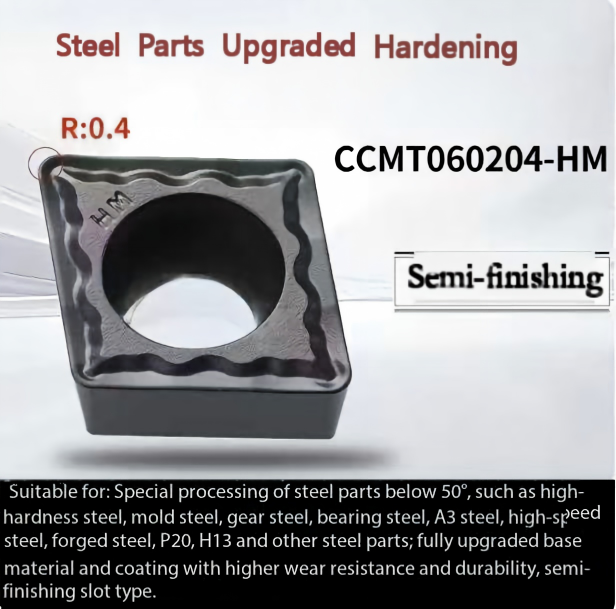
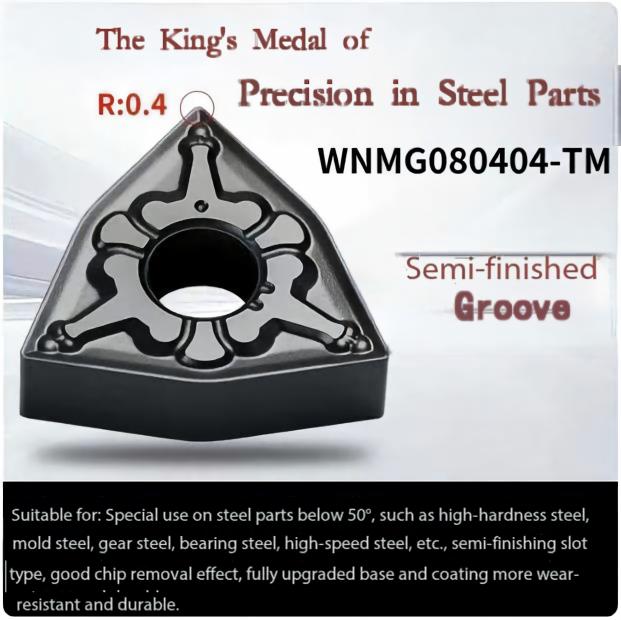
In a real machine shop, engineers and purchasing managers don’t care about how shiny an insert is. You care about one thing: Does it run smoothly, reduce downtime, and cut costs?
Let’s skip the marketing fluff and get straight to the point. Today, we’re breaking down the CCMT060204-HM (internal boring) and WNMG080404-TM (external turning) inserts. Designed specifically for steel parts under 50 HRC—like mold steel, gear steel, and bearing steel—this pairing is a highly reliable choice for your semi-finishing operations.
Why This Pair Works: Built for Synergy
- Simultaneous Inside & Outside Machining: One handles the bore, the other handles the OD. Having both in your tool crib saves tool change time, making it perfect for high-volume batch production of shafts and sleeves.
- Wide Material Coverage: High-hardness steel, mold steel, gear steel, bearing steel, A3 steel, and high-speed steel. As long as the hardness stays under 50 HRC, these inserts will handle it.
- Purpose-Built Chipbreakers: Both the HM (internal) and TM (external) geometries are engineered specifically for semi-finishing. They ensure stable chip breaking, smooth evacuation, and surface finishes easily hitting Ra ≤ 1.6μm without needing secondary polishing.
What Steels is the CCMT060204-HM Actually Good For?
Don’t be fooled by “universal” claims. This insert truly shines when machining:
- High-Hardness Steel (P20/H13): For pre-hardened steels sitting around 45-50 HRC, it cuts smoothly without chipping the edge.
- Mold & Gear Steel: These materials are tough and gummy. The wave-pattern chipbreaker of the HM geometry effectively prevents chip wrapping, protecting your finished surface from scratches.
- A3 & High-Speed Steel: Though not extremely hard, they tend to build up on the cutting edge. The upgraded coating significantly reduces built-up edge (BUE) issues.
⚠️ Heads Up: If your workpiece exceeds 50 HRC or contains tough elements like titanium or nickel, don’t force it. Switch to ceramic or CBN inserts instead.
How Good is the Chip Control on the WNMG080404-TM? Let’s Look at the Data
The core advantage of the TM geometry is “predictable chip breaking”:
- Consistent Chip Length: Under standard parameters (ap=1.5mm, f=0.2mm/r), chips form a clean “C” or “6” shape, staying between 15-25mm. No wrapping around the spindle, no scratching the part.
- Reliable Surface Quality: Even after 100 continuous pieces, surface roughness holds steady at Ra 1.2-1.6μm. No secondary grinding needed.
- The Sweet Spot: Compared to HF (roughing) grooves, TM gives a finer finish. Compared to HR (finishing) grooves, TM has a larger chip pocket, making it much more forgiving to depth-of-cut variations in semi-finishing.
💡 Insider Tip: If your chips are turning blue and brittle, your cutting temperature is too high. Drop the cutting speed slightly or increase coolant flow. If chips are getting too long and tangling, your feed rate might be too low, or the insert is wearing out.
Expanding Your Machining Arsenal: When to Use Round Inserts (RPMT)
While the CCMT and WNMG are your go-to tools for standard bores and straight turning, what if you have complex contours or need to tackle heavy stock removal?
This is where our RPMT1204MO-R6 Round Nose Insert comes into play. Unlike square or triangular inserts, the round insert offers superior strength and flexibility.
According to our guide on taming steel machining with round inserts, the RPMT is the ultimate solution for:
- Form Machining: Creating radii and complex profiles in a single pass.
- Heavy Stock Removal: The full-radius cutting edge distributes heat and wear evenly, allowing for higher metal removal rates.
- Vibration Damping: The round shape is inherently more stable when cutting interrupted surfaces or thin-walled parts.
👉 Read the Full Story: For a deep dive into maximizing efficiency on the shop floor using round inserts, check out our article: Shop Floor Reality: Taming Steel Machining with the RPMT1204MO-R6 Round Nose Insert.
Solving Real Buyer Pain Points
- Pain Point 1: Inserts wear out too fast.
Solution: We use an upgraded substrate with a multi-layer nano-coating. Wear resistance increases by 30%, dropping your cost-per-part by 15-20%. - Pain Point 2: Bad chip control causes machine downtime.
Solution: The TM/HM geometries are optimized for smooth chip evacuation, keeping your machine running and operators happy. - Pain Point 3: Sourcing costs are eating your margins.
Solution: Factory-direct pricing with tiered volume discounts. We also support OEM/ODM customization (coatings, substrates, sizes) to fit your exact needs.
CCMT vs. WNMG: Knowing Your Tools
- CCMT060204-HM: The internal boring specialist. The R0.4 nose radius is perfect for smaller bores. Its positive rake design reduces cutting forces, making it ideal for thin-walled parts.
- WNMG080404-TM: The external turning workhorse. The triangular shape offers superior rigidity and anti-vibration properties, handling larger depths of cut while maintaining a great finish.
- The Perfect Workflow: Machine a hydraulic cylinder sleeve by turning the OD with the WNMG (leaving 0.3-0.5mm stock), bore the ID with the CCMT to final size, and finish in one setup. Guaranteed concentricity, 40% faster cycle times.
FAQ: 8 Real Questions from the Shop Floor
- Can I use the CCMT060204-HM on stainless steel?
Yes, but stainless is gummy. Use dedicated coolant and drop your cutting speed by 20% to prevent work hardening. - What’s the difference between the TM and HM chipbreakers?
TM is for external semi-finishing with finer chips. HM is for internal boring with a larger chip pocket. They are not interchangeable. - Do these work with standard tool holders?
Absolutely. But for hard steels, we highly recommend using holders with internal coolant channels to maximize tool life. - When should I replace the insert?
Watch the flank wear (VB). Once VB ≥ 0.3mm, or if you see chipping/craters, swap it out immediately. - Can I use these for cast iron?
Not recommended. Cast iron is abrasive. Use KM or KF geometries instead. - What’s the MOQ for OEM customization?
Usually 500 pcs, but we can negotiate based on coating/geometry complexity. Standard items often allow smaller trial orders. - Is the packaging safe for shipping?
Yes. Each insert is individually blister-packed, anti-static bagged, and boxed to prevent any transit damage. - Can I get samples before committing?
Yes. We provide free samples for testing so you can validate performance in your specific application before placing a bulk order.
Ready to Upgrade Your Machining Process?
Whether you are a distributor looking for a reliable OEM partner with healthy margins, or a factory engineer trying to solve a tough machining problem, we’ve got you covered.
📩 Email us at mailto:yuenan47@gmail.com to get our full product catalog, technical data sheets, and wholesale pricing.
🔗 Click the link in our bio to enter our B2B portal for instant quotes, custom requests, and direct technical support.
🔗 Click the link in our bio to enter our B2B portal for instant quotes, custom requests, and direct technical support.
Don’t let inefficient tooling drain your profits. Choose the right insert, and win the production race.

1 Comment
How to Choose Ceramic Inserts for Steel Finishing? A Deep Dive into DNMG150404R-VF - JY Best Carbide
[…] solve this upstream issue, we highly recommend evaluating the CCMT060204-HM & WNMG080404-TM semi-finishing combo for your steel parts. This combination is specifically designed to handle the heavy stock removal and variable cutting […]