Stop losing profit on manual polishing. Discover why the 3-flute aluminum end mill D8x60L is the ultimate tool for high-gloss CNC machining and Ra < 0.4μm.
Getting Mirror Finishes Right: Why the 3-Flute Aluminum End Mill D8x60L is the Standard for High Gloss CNC Machining
In high-volume aluminum machining, post-processing is where profit margins disappear. For factories producing consumer electronics, automotive trim, or optical components, achieving a “mirror finish” often requires manual polishing. This introduces two critical problems: inconsistency in surface roughness (Ra values) and the high risk of scrapping expensive parts during final hand-finishing.
The solution isn’t better polishing compounds; it is selecting the correct cutting geometry from the start. For deep-cavity aluminum parts requiring high-gloss surfaces, the 3-flute aluminum end mill D8x60L for high gloss CNC machining has become the industry standard. It effectively bridges the gap between roughing efficiency and finishing quality, specifically addressing the challenges of sticky aluminum alloys like 6061-T6 and 7075.
Real Shop Floor Pain Points in High-Gloss Aluminum
When chasing a mirror finish on aluminum, machinists typically fight three main issues:
- Built-Up Edge (BUE): Aluminum is soft and gummy. At high speeds, it welds to the cutting edge, tearing through the workpiece instead of shearing cleanly. This leaves micro-scratches that ruin glossy surfaces.
- Chip Evacuation in Deep Cavities: A 60mm total length implies long reach for deep pockets. Long tools are prone to vibration (chatter), and deep cavities trap chips. Recutting chips is the fastest way to destroy surface integrity.
- The 2-Flute vs. 4-Flute Trap: 2-flute end mills offer great chip clearance but lack rigidity, leading to chatter and poor surface finish. Conversely, standard 4-flute tools lack the gullet space needed for aluminum, causing clogging.
The 3-flute aluminum end mill D8x60L solves this dilemma by optimizing both chip evacuation and tool rigidity.
The Geometry Advantage: Why 3 Flutes Win
The 3-flute design is an engineering optimization for non-ferrous finishing. Here is why it outperforms traditional options:
- Optimized Chip Load & Surface Finish: Three cutting edges maintain a higher frequency of cuts per revolution than a 2-flute tool. This reduces forced vibration amplitude, resulting in a smoother surface texture directly off the machine.
- Superior Chip Evacuation: The gullets on a 3-flute aluminum end mill are significantly larger than those on a 4-flute cutter. This allows for efficient chip removal in deep 60mm reach configurations, preventing the recutting that destroys glossy finishes.
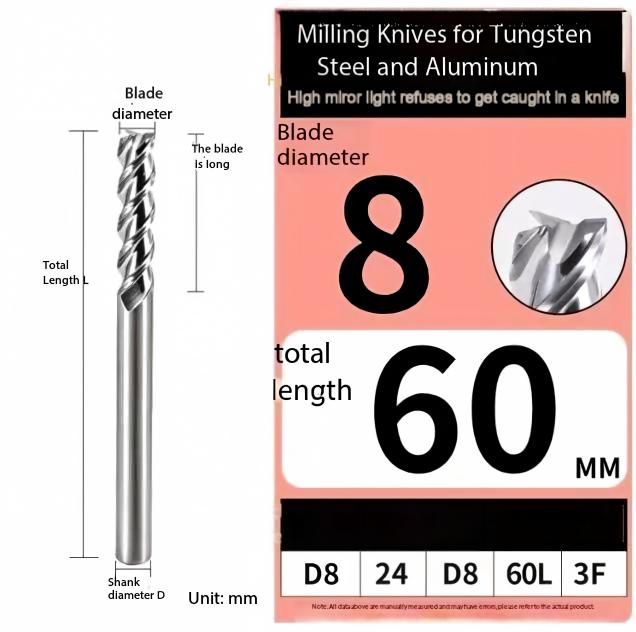
- Core Strength for Long Reach: The D8x60L specification (8mm diameter, 60mm overall length) is a slender ratio. The 3-flute design offers a larger core diameter than a comparable 2-flute tool. This extra core mass increases rigidity, reducing deflection and chatter when extended deep into a pocket.
Material Science: Submicron Carbide & Polishing
Perfect geometry will fail if the substrate and coating are incorrect. High-gloss aluminum machining demands submicron or ultra-fine grain carbide substrates (typically 0.5μm to 0.8μm grain size). Fine grains allow for sharper cutting edges without sacrificing toughness. A sharp edge shears aluminum cleanly; a dull edge rubs, generating heat and causing material adhesion.
Additionally, look for tools with highly polished flute surfaces or specialized DLC (Diamond-Like Carbon) coatings. Aluminum has a strong chemical affinity for carbide. A mirror-polished flute reduces friction and prevents chips from sticking. Premium manufacturers also use variable helix angles (e.g., 35°/37°) combined with unequal index spacing to disrupt harmonic resonance frequencies, damping out chatter that causes surface waviness.
Practical Machining Parameters for D8x60L
Theory must translate to machine performance. Below are proven starting parameters for machining 6061-T6 aluminum with a D8x60L 3-flute end mill for high-gloss results:
表格
| Parameter | Semi-Finishing | High-Gloss Finishing |
|---|---|---|
| Cutting Speed (SFM) | 450–600 m/min | 1000–1500 SFM |
| Feed per Tooth (fz) | 0.06–0.08 mm/z | 0.02–0.05 mm/z |
| Depth of Cut (Ap) | 0.5xD (4mm) | 0.1–0.2mm |
| Stepover (Ae) | 20–30% | 3–5% (Trochoidal/Scan) |
| Coolant | Flood | High-Pressure Mist or Air Blast |
Insider Tips for Shop Floor Engineers
- Climb Milling is Non-Negotiable: Always use climb milling (down milling) for aluminum finishing. Conventional milling lifts the material and increases BUE formation. Climb milling ensures the tooth engages at maximum chip thickness and exits at zero, promoting a clean shear.
- Use Compressed Air Over Flood Coolant: For high-speed finishing, compressed air is often superior. It evacuates chips instantly and prevents thermal shock to the carbide. If using coolant, ensure it is properly filtered and aimed directly at the cutting interface.
- Minimize Stick-Out: Only expose the length necessary for the depth of cut plus a small safety margin. Every millimeter of unnecessary stick-out exponentially decreases rigidity. Use hydraulic or shrink-fit holders over standard collet chucks for superior runout accuracy (<0.003mm).
See the Tool in Action
Before tweaking your parameters, take a look at how this tool actually performs in real-world aluminum machining:
FAQ: Technical Questions from Machinists
Can I use a standard TiAlN coated end mill for mirror finish aluminum?
Generally, no. TiAlN retains heat, which increases the risk of chip welding in soft aluminum. Uncoated polished carbide or specialized DLC/ZrN coatings are required for high-gloss finishes.
Generally, no. TiAlN retains heat, which increases the risk of chip welding in soft aluminum. Uncoated polished carbide or specialized DLC/ZrN coatings are required for high-gloss finishes.
Why does my aluminum part look hazy even with a new end mill?
Hazy finishes are usually caused by tool runout, rubbing instead of shearing, or chip recutting. Check your tool holder for accuracy (<0.003mm runout) and ensure your SFM and chip load are high enough to prevent rubbing.
Hazy finishes are usually caused by tool runout, rubbing instead of shearing, or chip recutting. Check your tool holder for accuracy (<0.003mm runout) and ensure your SFM and chip load are high enough to prevent rubbing.
Is a 3-flute better than a 2-flute for finishing 6061 aluminum?
Yes, for long-reach finishing. While 2-flutes offer better chip clearance, 3-flutes provide the core rigidity needed to prevent chatter at 60mm lengths, resulting in a superior surface finish.
Yes, for long-reach finishing. While 2-flutes offer better chip clearance, 3-flutes provide the core rigidity needed to prevent chatter at 60mm lengths, resulting in a superior surface finish.
The Bottom Line for Purchasing Managers
When sourcing the 3-flute aluminum end mill D8x60L for high gloss CNC machining, calculate the cost per finished part, not just the unit price. A cheaper tool that requires 10 minutes of manual polishing per part is infinitely more expensive than a premium tool that delivers Ra < 0.4μm straight off the CNC.
For factories aiming to automate finishing processes and eliminate bottlenecks, investing in geometrically optimized, high-quality 3-flute end mills is a process improvement strategy. By understanding the interplay between flute count, core strength, and surface treatment, you can consistently achieve mirror finishes that meet demanding specifications while protecting your margins.
While the 3-flute D8x60L is your secret weapon for high-gloss finishing, you shouldn’t overlook the workhorse of general-purpose aluminum machining. For high-efficiency roughing and finishing where extreme chip evacuation isn’t the primary concern, a 60-degree helix 4-flute carbide end mill is often the best-selling inventory item for job shops. It strikes the perfect balance between tool life, finish, and cost-per-part for a wide range of applications. Discover why this 4-flute design should be your default choice for general inventory.
Ready to Optimize Your Aluminum Machining Process?
We specialize in high-performance carbide tooling for the B2B sector. Our D8x60L 3-flute series is engineered specifically for high-gloss aluminum applications.
We specialize in high-performance carbide tooling for the B2B sector. Our D8x60L 3-flute series is engineered specifically for high-gloss aluminum applications.
- Wholesale Inquiries: Competitive tiered pricing for factory volume.
- OEM Solutions: Custom geometries and coatings tailored to your specific alloy and cycle time requirements.
[Contact Us Today for a Free Tooling Audit & Sample Request]